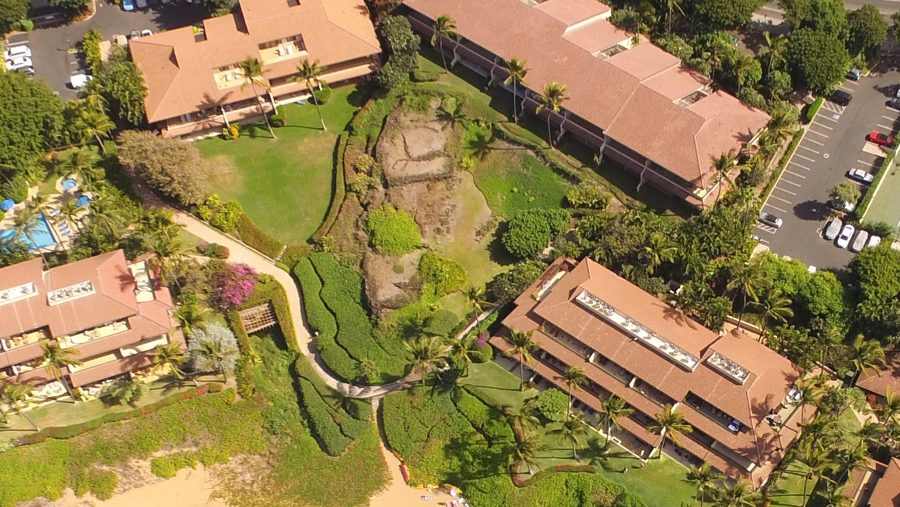
Walk the path from the buildings down to Po'olenalena Beach and it curves around the base of a rocky, overgrown knoll. Most guests walk right past it. At the top, behind the plants and barely visible from below, is a low wall of dark, dry-stacked stone. It's a heiau, a Hawaiian place of worship. This one is a ko'a, a fishing shrine, and it was here long before the condos, the golf courses or the road.
Two meanings of one word
In Hawaiian, ko'a means two things that belong together. One is a fishing ground out at sea, a spot where fish gather, found by lining up landmarks on shore. The other is a shrine on land, a stone structure where fishermen asked for a good catch and gave thanks for it.
Fishing heiau like this one did several jobs at once. Families came to pray for safety and calm seas before going out. The first fish of a catch was brought back and offered here. Shrines on high ground near the water could also serve as landmarks for finding fishing grounds offshore, and as lookouts for spotting schools of fish.
The fish god of Maui
Maui has its own story of where these shrines came from. The fish god Kū'ula-kai and his wife Hina lived at Hāna, where Kū'ula built a shrine beside his fishpond and offered his first fish there. Their son, 'Ai'ai, set the first kū'ula stone on land and then traveled the islands founding fishing shrines.
The rules he taught are simple, and they still say a lot about this coast: the first fish goes to the god, a share goes to whoever comes to help, and you never take everything.
A land that lived on fish
Makena Surf sits in Honua'ula, the old district that runs from Wailea south to La Pérouse Bay. It's a dry land with little rain, and its people survived on the ocean. The name Mākena itself means "abundance." Ke Alaloa, the King's Trail, ran along this shore from Wailea south to Po'olenalena and Maluaka, linking the fishing villages of the coast.
This was a fishing beach within living memory. In interviews recorded in 2003, Mākena families described the akule runs. A spotter watched from shore for the dark shape of a school moving into the bay. Then canoes went out and closed it off with a ti-leaf rope and nets, and the fish were drawn up onto the sand. Everyone who came down to help went home with a share. One fisherman remembered the south end of this beach as one of their akule spots.
Some of those families still fish here today.
Why it's still here
Over the last century, much of this coast changed from fishing villages to ranch land to resorts. As it did, many of the old shrines along the shore were lost. Before Makena Surf was built, Bishop Museum archaeologists surveyed the land. When construction began in 1984, the heiau was kept in place, and it is protected on the grounds today.
That makes it rare: a fishing heiau still standing on the shore it was built to watch over, a few steps from the beach where akule nets were once pulled onto the sand.
Visiting with respect
The heiau is closed to entry, and we ask our guests to treat it the way Hawaiians ask everyone to treat their sacred places:
- Enjoy it from the path, and keep your voice low. Please don't climb the knoll.
- Don't move, stack or take any rocks. The walls are dry-stacked, with no mortar, and they're fragile.
- Don't leave offerings. Ti-wrapped rocks aren't a Hawaiian tradition, and coins, candles and flowers damage the stones. Quiet respect is the right offering.
Hawai'i State Parks explains these customs in its guide to visiting sacred places.
When you're down on the beach in the morning, watching the water for turtles, you're doing what people on this shore have done for centuries: watching the ocean and waiting to see what it brings.